

Candidate dropouts are frustrating for recruiters.
They also derail business plans, delay execution, and quietly add cost to the system.
What often gets missed is the real cost of dropouts — the hours spent by multiple stakeholders across levels: recruiters, interviewers, hiring managers, leadership. When a candidate drops out late in the process, all of that investment is lost.
While dropouts can never be eliminated entirely, they can be predicted and significantly reduced if addressed consciously.
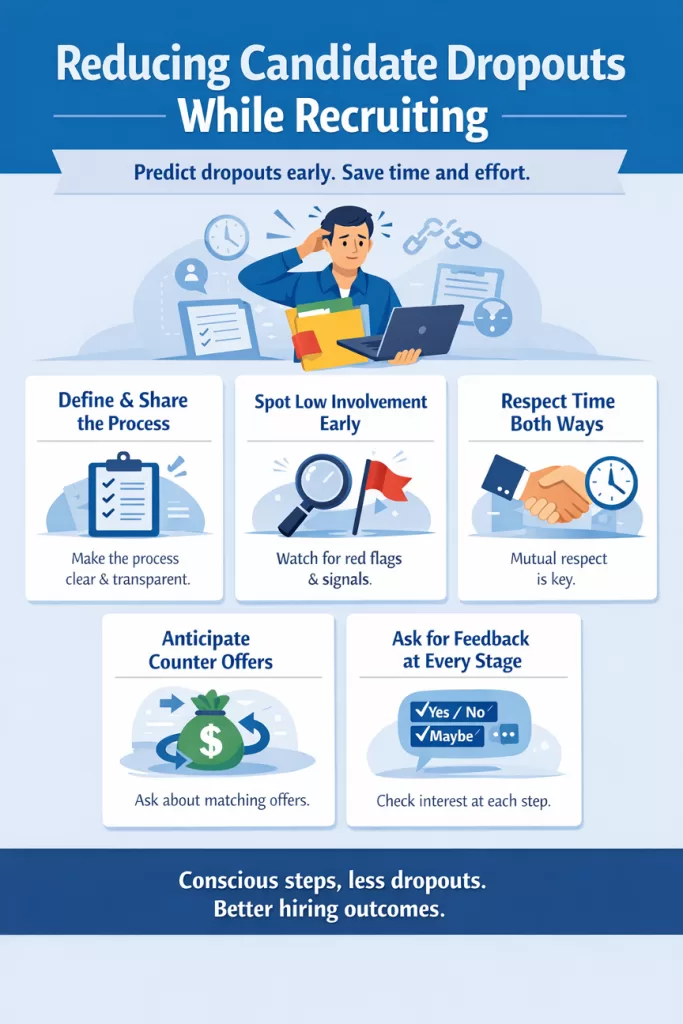
Here are 5 practical steps recruiters can take to reduce candidate dropouts.
1. Have a defined and transparent recruitment process
A well-defined recruitment process sets the tone for seriousness — for both the organisation and the candidate.
Make the process transparent to all stakeholders, including applicants. Candidates should clearly understand:
- The stages involved
- The level of interaction required
- The time and effort expected from them
When candidates know the involvement and investment required from everyone, commitment improves.
2. Spot early signs of low involvement
Low involvement usually shows up early — missed calls, delayed responses, vague answers, repeated rescheduling.
Train recruiters to:
- Identify these red flags early
- Note how often they occur
- Track at which stage they show up
Use this data to predict involvement levels.
Most importantly, document and share these red flags in a tracking system so everyone
involved can re-check and validate before moving ahead.
Recruiters should evaluate not just the candidate’s skills, but also their intent and seriousness.
3. Respect the candidate’s time — and expect the same
Respecting a candidate’s time builds trust and engagement.
But this has to be mutual.
If a candidate repeatedly shows a lack of respect for timelines or commitments, pause and evaluate:
- Is this still the right candidate to invest in?
- Are we ignoring early signals because the profile looks good?
Good hiring is as much about behaviour and intent as it is about capability.
4. Understand the likelihood of matching or counter offers
In many organisations, matching or counter offers are standard practice to retain talent.
Identify early if the candidate works for such an employer. Ask direct questions:
- What would you do if your current employer makes a counter or matching offer?
- Why are you really looking to make a change?
Then cross-check this response with the reasons they’ve shared for wanting to move. Inconsistencies here often predict late-stage dropouts.
5. Ask for feedback at every stage
Engagement indicates interest.
Encourage candidates to share feedback after each stage of the process. Keep it simple and low-effort — quick responses like Yes / No / Maybe work well.
At the end of the feedback, ask one clear question:
“Are you interested in moving to the next stage?”
In many cases — especially in the Indian context — it is easier for candidates to say no over text than directly to a recruiter. This honesty helps everyone save time and avoid surprises.
Consciously addressing candidate dropouts, tracking patterns, and refining your approach as you go will help you predict disengagement early.
The result:
Less wasted effort.
Fewer last-minute surprises.
And a much smoother recruitment experience — for recruiters and candidates alike.
Leave a Reply